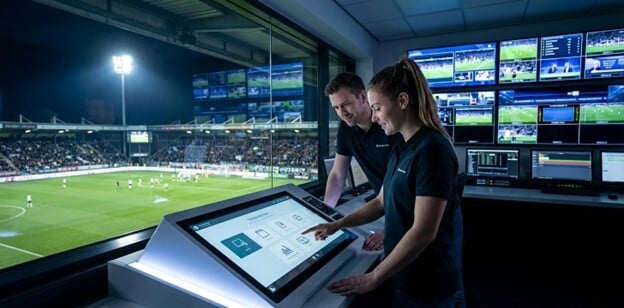
As stadium screens grow larger and fan expectations become more sophisticated, the technology required to run a live event has reached broadcast-level complexity. However, a silent crisis is emerging in the control room: the technology has outpaced the availability of specialized talent required to operate it. For venue operators, solving this talent shortage requires a fundamental shift in how game-day productions are engineered.
The Challenge: The Broadcast Talent Bottleneck
In traditional workflows, producing a high-end, dynamic venue show requires a small army of highly specialized technicians. You need 3D animators to build the assets, broadcast engineers to route the signals, and specialized software operators to trigger the graphics.
For a marquee, nationally televised event, this overhead is expected. But what about a Tuesday night minor league game, a mid-tier collegiate matchup, or a corporate venue buyout? Hiring premium freelance broadcast talent for every single event destroys operational margins. The result is a widening gap between what the stadium's multi-million-dollar screens are capable of displaying and what the available game-day staff can actually execute.
"The complexity of live production technology has outpaced the availability of skilled operators, making intuitive, template-driven workflows a necessity, not a luxury."
– Ken Kerschbaumer, Sports Video Group
The Operational Pivot: Democratizing the Workflow
The solution is not to lower the quality of the show, nor is it to endlessly inflate the HR budget. The solution is to democratize the technology. By moving the complex coding and 3D rendering into the background, venues can empower versatile, non-specialized game-day staff to execute cinematic, data-driven shows.
Key Insight: At venue4D™, we believe the software should do the heavy lifting. Using a real-time, template-driven architecture, a single operator can trigger broadcast-quality, responsive 3D graphics simply by entering a player's name or a live statistic—no advanced degree in computer animation required.
3 Benefits of a Democratized Control Room
- Reduced Operational Overhead: Venues can drastically reduce reliance on expensive, specialized freelance operators for day-to-day events, protecting profit margins.
- Agile Staffing Models: Intuitive interfaces enable rapid onboarding of student workers, interns, or cross-trained staff, ensuring the control room is never short-staffed.
- Consistent Brand Quality: Because the high-end design is baked into the templates, the show's visual integrity remains flawless, regardless of who is in the operator's seat.
Conclusion: Empowering the Operator
The future of venue technology isn't just about making graphics look better for fans; it's about making tools more accessible to staff. By investing in software-defined, template-driven workflows, venues can solve the production talent shortage and ensure their multi-million-dollar screens always look their best, no matter who is running the board.
Empower your game-day staff.
Discover how platforms like venue4D™ are democratizing the control room to deliver broadcast-quality graphics with point-and-click simplicity.
Contact us for more information