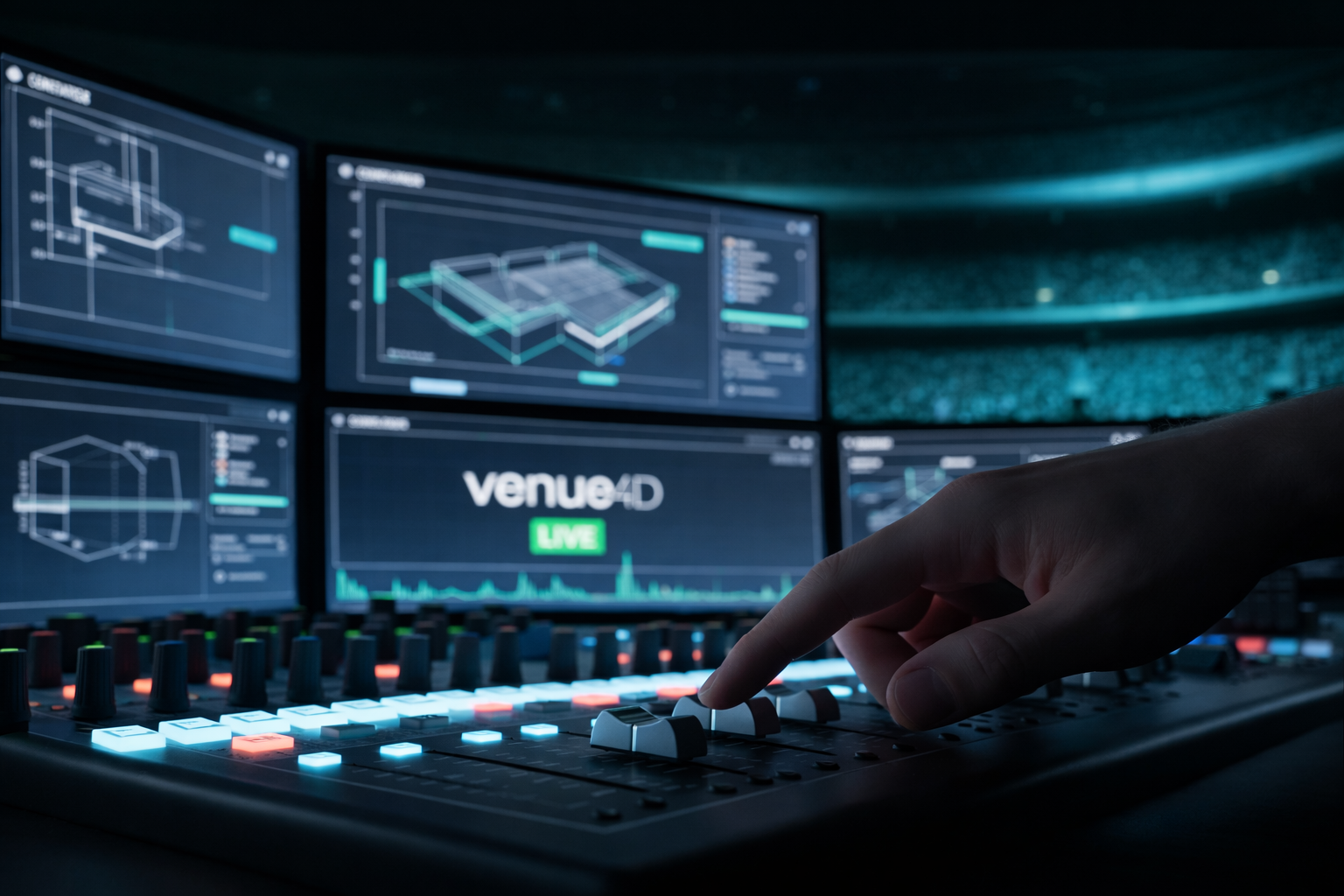
For venue CTOs and IT directors, the game-day tech stack has become a complex ecosystem of competing priorities. The goal is to deliver a spectacular fan experience, but the reality often involves juggling legacy systems, managing static video workflows, and dealing with the high costs of producing custom content.
The old model of pre-rendered video packages simply can’t keep up with the demand for dynamic, interactive, and data-driven moments that define modern sports entertainment.
The Bottleneck of Legacy Workflows
Traditional in-venue graphics are built on a foundation of pre-rendered video files. This workflow, while familiar, presents significant technical and operational challenges:
- High Production Friction: Every sponsor integration, every new fan prompt, and every themed night requires a time-consuming production cycle of design, rendering, and exporting.
- Rigidity: This creates a rigid system that is slow to adapt and expensive to maintain.
- Fragmentation: This approach often results in a fragmented tech stack with disparate systems for the main jumbotron, ribbon boards, and concourse displays.
For a technical leader, this means more points of failure, complex integration challenges, and a lack of unified control. The core issue is that these systems are passive; they play back media but cannot react to the live, unpredictable energy of a sporting event.
Key Takeaway: Static, pre-rendered content workflows limit creative possibilities, inflate operational costs, and prevent venues from delivering the truly responsive experiences modern fans and sponsors expect.
The Architectural Shift: Real-Time Graphics Engines
The solution lies in a fundamental architectural shift: moving from pre-rendered playback to a live, real-time graphics platform. By leveraging powerful game engines, venues can now render cinematic-quality 3D graphics on the fly, creating experiences that respond instantly to what’s happening in the game, in the stands, and in the data feed.
"The shift from pre-rendered clips to real-time interactive graphics is not just an upgrade; it is a re-platforming of the entire in-venue experience. It allows for a more modern, reliable, and modular solution that can future-proof a venue's tech stack."
– venue4D™ Strategic Insight
At its core, a platform like venue4D™, powered by the Unreal Engine, replaces clunky, disparate systems with a single, cohesive engine. This unified approach offers several key advantages for technical teams:
- Simplified Operations: A central interface controls content across all venue screens—from the primary jumbotron to auxiliary and ribbon boards—drastically reducing complexity.
- Template-Driven Efficiency: Instead of building every graphic from scratch, operators use configurable templates. Branding, sponsor logos, and prompts can be changed instantly without any rendering, enabling scalability and reducing reliance on specialized designers.
- True Interactivity: Real-time rendering is the prerequisite for genuine interactivity. The system can process live data inputs and reflect them in the on-screen visuals in milliseconds, not minutes.
Unlocking New Dimensions of Fan Engagement and Data
This new technical foundation unlocks a new tier of fan experience that was previously impossible. It's not just about better-looking graphics; it's about creating a smarter, more engaging environment.
Data-Aware and Environment-Aware Visuals
Imagine graphics that are directly tied to the action on the field. With Live Data Visual Templates, real-time player stats, scores, and game-state updates are integrated directly into on-screen graphics, creating a seamless, informative experience for fans. Beyond game data, Audio-Reactive Templates allow the crowd itself to become an input, translating noise levels into dynamic motion and visual intensity on the screens.
The Rise of Immersive, Interactive Moments
While the industry talks about VR and AR, the most scalable immersive experience is one that the entire crowd shares together. This form of fan engagement is being used to create immersive fan experiences that don't require headsets.
With a real-time engine, you can transform the entire venue's atmosphere with a click. A normal timeout can become a sponsor-branded trivia game, an immersive "space galaxy" theme night, or an interactive poll where thousands of fans participate via their phones. Following a Screen-First, Not Mobile-First principle, phones act as simple controllers, while the spectacular payoff resolves on the big screens, preserving the shared, collective energy of the event.
Conclusion: Future-Proofing Your Venue's Tech Stack
Technology is no longer just a supporting player in the fan experience—it is the main event. For technical leaders, the move to a real-time, template-driven graphics platform is a strategic imperative. It streamlines workflows, reduces long-term operational costs, and provides a flexible, powerful foundation to build the next generation of sports entertainment.
By embracing this architectural shift, you can deliver the dynamic, interactive, and unforgettable moments that will define the fan journey for years to come.
To see how the venue4D™ platform is built to simplify operations and amplify engagement, visit venue4d.com.