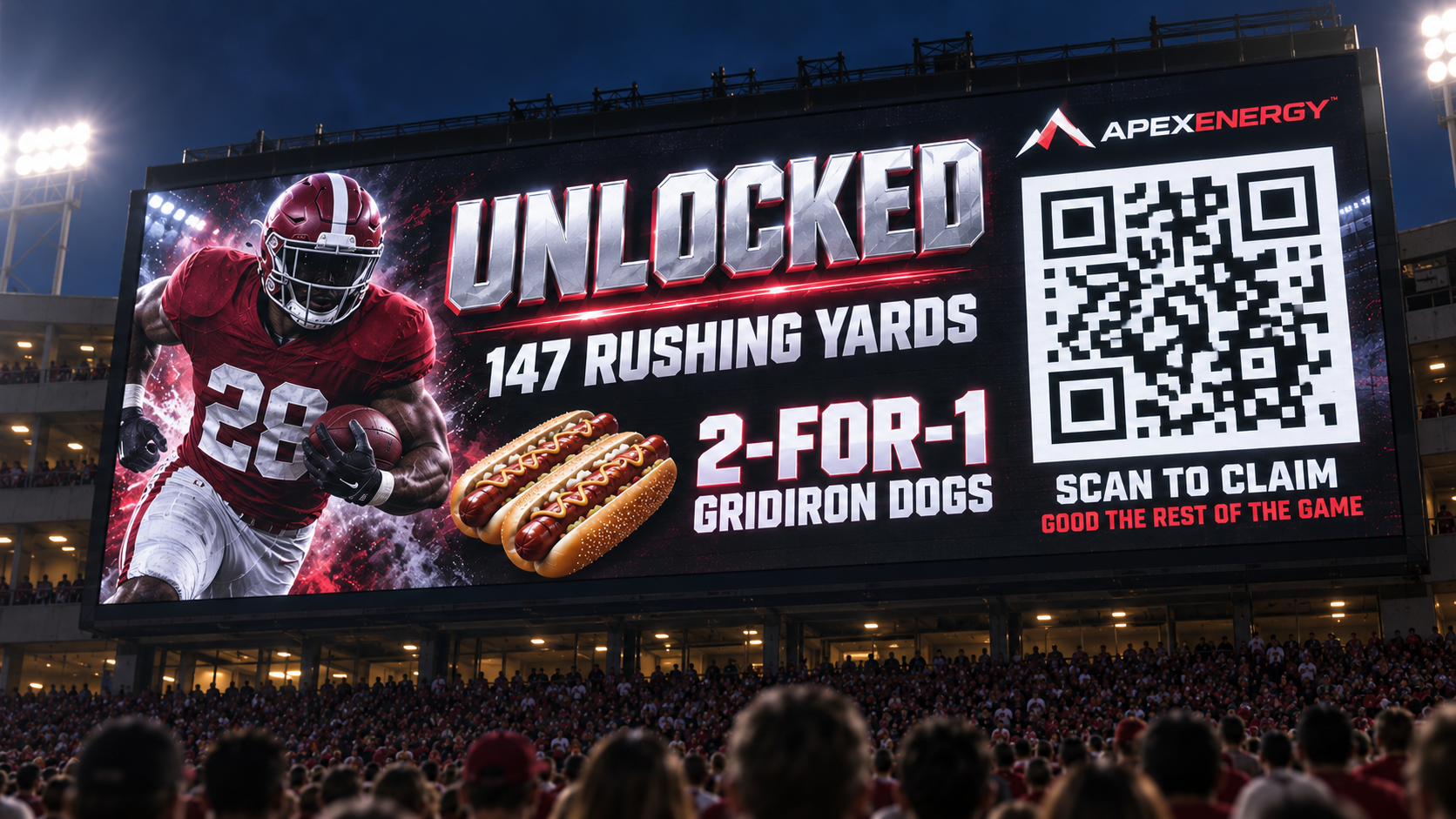
Six minutes left in the third quarter, and your back is sitting on 82 rushing yards. The board says so — not as a stat line, but as a countdown. Eighteen yards from 2-for-1 at the concession stands, courtesy of a sponsor whose logo has been attached to that number since the first quarter. Every carry from here is a sponsor exposure nobody had to buy separately, and fifty thousand people are doing the arithmetic.
The Tease Is the Inventory
Most in-venue promotions are a single moment. A graphic appears during a timeout, sits on the board for thirty seconds, and leaves. The sponsor bought one impression, the venue delivered it, and nobody remembers it by the fourth quarter.
Tie the same promotion to a live number and the shape changes completely. The offer is announced before kickoff. It reappears at 40 yards, at 60, at 82, at 94 — and then it unlocks. That is five or six appearances instead of one, and none of them is a repeat, because the number is different every time. Fans tolerate an update in a way they will never tolerate the same static read run six times. The tease is not the setup for the inventory. The tease is the inventory.
The unlock structure itself is well proven. Taco Bell has run Steal a Base, Steal a Taco in most World Series since 2015, where a stolen base unlocks a free taco nationally. But a stolen base is binary and instantaneous: it happens, or it does not. A yardage threshold behaves like a progress bar, and a progress bar can be shown all afternoon. For a venue selling screen time, that difference is the whole opportunity.
What Makes It Work Is the Data Binding
The mechanic depends on one thing: the number on the board is not typed in; it is bound.
In a real-time graphics system, the promotional CTA is a template with a live field, and that field points to the same stat feed the sports information office already uses to run the box score. Nobody is rebuilding a graphic at 82 yards. The template was built once, in the preseason, with the threshold as a setting; the number updates because the feed updated. An operator decides when to put it on the board, not what it says.
Two operational details matter more than they sound. First, keep the unlock behind one operator confirmation rather than firing it automatically, because live stat feeds get corrected, and a promotion that unlocks on a number revised down two minutes later is a problem you cannot un-ring. Second, bind once and publish everywhere: the same template drives the main board, the ribbon, the concourse displays, and the app push, so the count updates in five places without five people touching five files.
This is the practical version of the shift to live engagement metrics — not a dashboard someone reads on Monday, but game data driving what is on the screen while the game is still happening.
💡 Related reading: Beyond the Roar: Using Data Analytics to Supercharge Venue Marketing — the wider case for treating venue screens as instruments that produce data rather than surfaces that display it.
Change It Between Games. Change It During One.
Because nothing is baked into a video file, the condition is a setting, not a build. That is where the operational advantage actually shows up.
Between games. Rushing yards works against a team that cannot stop the run. The following week you are facing an offense that throws forty times, so the trigger becomes a takeaway count or a third-down stop threshold. Same template, same sponsor, different condition, and the change takes an afternoon, not a production cycle.
During the week, late. A local partner closes on Thursday and wants to be on the board Saturday. Under a pre-rendered package: a polite no, or a rush invoice and a file that arrives Friday night. Under a bound template it is a logo swap and a threshold.
During the game itself. The forecast turns and it is forty degrees at kickoff, so the offer moves from soda to hot chocolate at halftime. Concessions calls up to say the chicken tenders are moving slowly and there are four hundred portions to clear. A sponsor watching from a suite asks whether their brand can be on the next one. Each is a live decision, and each is available only if the graphic was never a finished video in the first place. It is the same capability behind changing a venue's look in seconds rather than weeks, applied to revenue instead of branding, and it is the concrete argument for moving from pre-rendered to real-time.
Worth setting the guardrails before the season, not during it. Decide who can approve a change mid-game, agree with the sponsor whether they are buying a fixed pool of redemptions or subsidizing per unit, and know where the pool runs out — a trigger is an option, and the venue is the one writing it.
What the Sponsor Gets
The pitch changes in a way sponsors notice. Instead of an estimated impression count, a partner gets an exposure log: the promotion appeared six times, at these moments, for this long, on these surfaces. Instead of a guess at effect, they get a redemption count from the point of sale — and the redemption is the number that matters, because scans flatter everyone while a scan that never reaches a register bought nobody anything.
That is a different category of asset than a logo bug, which is the practical argument behind memorable in-stadium experiences, and the direction of travel is measurable industry-wide. Nielsen analyzed 100 sponsorships across 2020 and 2021 in seven markets and twenty industries, and found sponsorships drove an average 10% lift in purchase intent among the exposed fanbase.
“Sponsorship activations have transitioned from simply raising brand awareness to actually converting consumers into customers.”
Redemption doesn't have to happen in your building, either. Point the code at a partner's storefront and give it a tail — unlocked tonight, live for forty-eight hours at their locations — and the board is no longer moving concession volume; it is moving retail traffic into a partner's business, measured on the partner's own terminals. For a local restaurant group, a credit union or a grocery chain, that is a materially larger thing to sell than a corner logo.
It Is Not Only Football
Any sport with a live stat feed has a threshold worth teasing. A volleyball match has a kill count and a service run. Basketball has a three-point total that a student section will absolutely track out loud. Soccer has a clean sheet that becomes more interesting every minute it survives. The smaller sports are also where this is easiest to run, because the crews are lean and the margin for production work is thin — which is exactly when a template that reconfigures itself beats a file that has to be rebuilt. The same logic extends to in-venue digital games and interactive experiences, which live or die on the same ability to change without a render.
The question stops being what to put on the board during the next media timeout. It becomes: what is happening on the field right now that a sponsor would pay to be attached to, and can we get it on the screen before the moment passes? A venue that can answer yes has turned its stat feed into inventory, and its videoboard into something closer to a live storefront than a billboard.
Ready to Elevate Your Venue Strategy?
See how venue4D™ helps leading venues turn live moments into measurable revenue.
Talk to venue4D