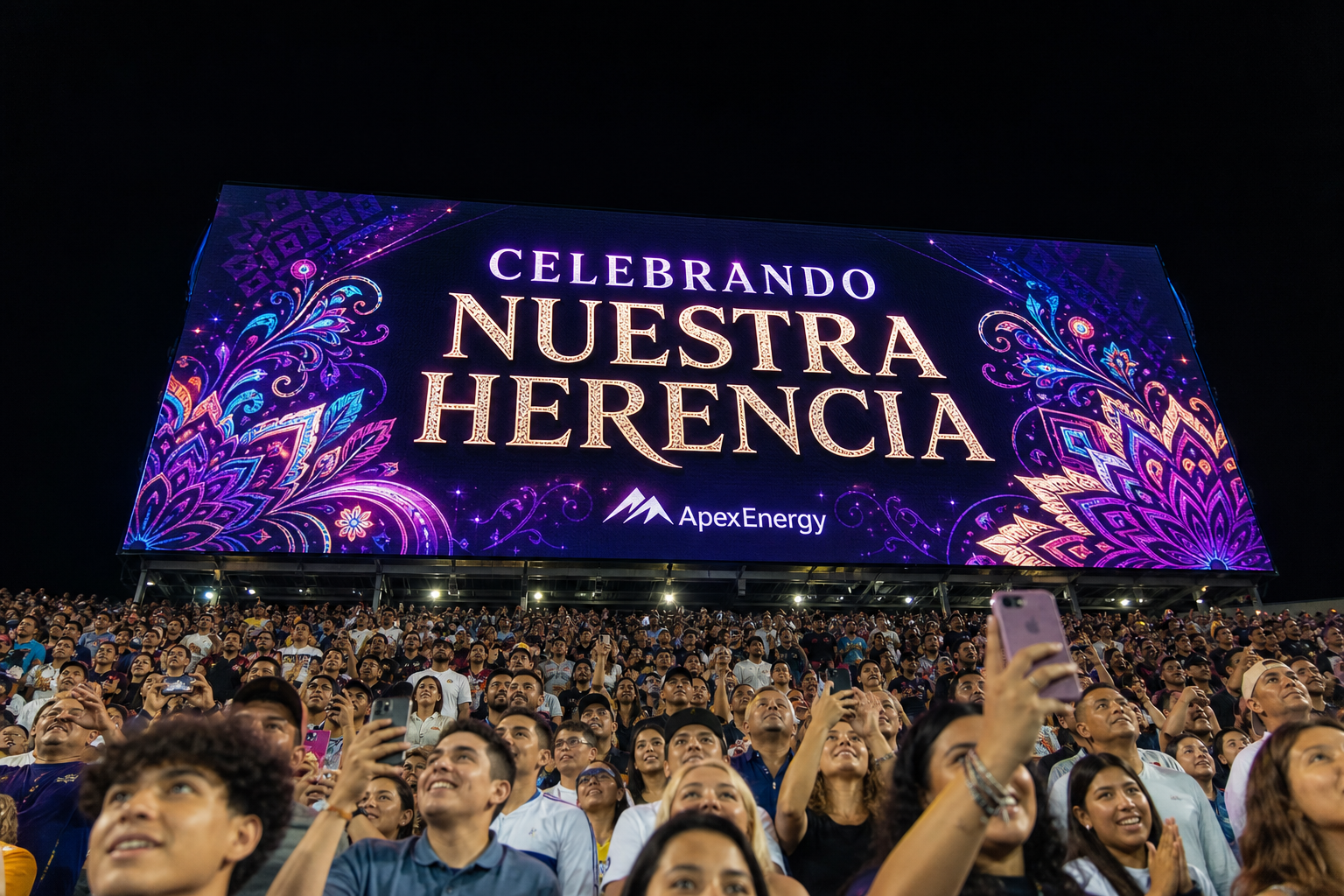
Hispanic Heritage Month runs September 15 to October 15. That is the first thing most venue production plans get wrong about it, because the calendar entry usually reads “theme night” and points at a single Saturday. For a football program those thirty days hold two or three home dates. Add soccer and volleyball and the number climbs. Treating a month as one evening is the same shortcut the plan is supposed to avoid.
Start With a Conversation, Not a Design File
The step that separates a credible production from a decorative one costs nothing and happens before any asset is built: talk to the people the month is about. Most campuses have a Latino student organization, a cultural center, a Hispanic faculty and staff association, or all three. They know which traditions matter locally, which framing lands as respectful, and which stock gestures read as hollow to the students actually in the stands.
Bring them the production plan while it can still change — board content, music, in-game features, concourse activity — and ask what is missing and what to drop. That conversation is also where genuinely local material comes from: an alumna worth a player-spotlight-style feature, a community organization that belongs on the board, a story specific to your institution rather than to the month in general. Nothing produced without that input will feel like it came from your campus, because it did not.
Foundational Graphics: A Look That Holds for a Month
Once the substance is settled, the visual layer has to carry across every date in the window, not one. That is the operational difference between a theme night and a theme period: the package has to be rebuilt for each opponent, each sport and each roster while keeping one identity.
A workable checklist covers primary board content first — player features, matchup graphics, score bugs carrying the event's typography and palette — then the surfaces that get forgotten: ribbon boards, concourse screens, entry displays, the loop that runs while people are still finding their seats. Template-driven systems are what make this affordable across multiple dates, letting a small crew re-skin a venue for each game the way they would for any seasonal campaign, instead of commissioning custom production per fixture.
One caution on language. If Spanish appears on the boards, have a native speaker on campus check it — not a translation tool. A grammatical error in a celebration of Hispanic heritage is the kind of detail students photograph and share, and it undoes the whole effort in a single post.
💡 Related reading: How In-Venue Digital Games & Fan Polling Are Redefining Fan Engagement — how interactive, fan-driven moments hold attention during breaks in play.
Activations That Could Only Run on Your Campus
Breaks in play are where participation happens, and where a generic package is most obvious. A trivia round about Hispanic athletes in general could run in any building in the country. A trivia round about Hispanic athletes who played for your program, answered by a student section that recognizes half the names, could not.
The same test applies everywhere. A walk-up song vote drawn from artists the campus community actually chose beats a stock playlist. A feature on a first-generation student from the local area beats a generic history slide. A halftime recognition of a Hispanic-owned business that has sponsored the program for a decade beats a logo card. All of these build community through a live event rather than decorating one, and each gets stronger when the campus organizations helped choose it.
Spread them across the window as well. Running everything on one night and reverting to the standard package for the next home game tells the audience exactly how deep the commitment went.
Sponsorship That Adds Rather Than Interrupts
A well-produced heritage period is real inventory, and it is worth more than a logo slot — but only if the integration is additive. A partner presenting the player feature or the trivia round is participating in the moment. A standard commercial break dropped into the middle of it is not, and the audience can tell the difference immediately.
The strongest version reaches past the usual partner list. Local Hispanic-owned businesses on the concourse, community organizations featured on the board, a partner underwriting something that continues after October 15 — these signal that the month was not a marketing window. That is what makes the package defensible to a sponsor looking for genuine community alignment, and it is a more durable route to stronger returns through interactive fan engagement than another impression count.
The venues that get this right treat the thirty days as a production period with a plan, a look, and a set of moments earned from the community it is honoring. The ones that do not run a nice-looking Saturday and wonder why nobody remembered it in November.
Ready to Elevate Your Venue Strategy?
See how venue4D™ helps leading venues turn live moments into measurable revenue.
Talk to venue4D