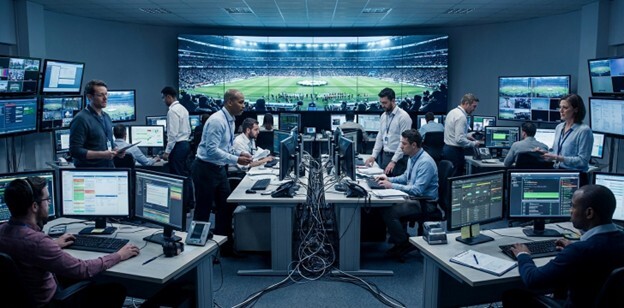
In the digital-first era of live events, venue technology has evolved from a supporting role to the main act. The modern fan expects a seamless, broadcast-quality experience from their seat, yet many venues struggle to deliver, burdened by the hidden costs of their tech stacks. The problem lies in the integration fallacy: the well-intentioned but flawed belief that a collection of "best-in-class" point solutions will combine to create a superior system. In reality, this patchwork of disparate technologies often creates a rigid, inefficient ecosystem that cripples operational agility and stifles innovation.
For years, venues have accumulated technology piece by piece—a scoreboard controller from one vendor, a ribbon board system from another, and separate software for digital signage and fan engagement. While each component may excel at its specific task, the friction between them introduces significant operational and financial drains that are often hard to see but deeply felt on game day.
The Hidden Costs of a Fragmented Ecosystem
A fragmented tech stack creates a cascade of inefficiencies that extend far beyond the control room. The reliance on disconnected systems forces venues into a labor-heavy operational model where simple tasks become complex, multi-step processes. This introduces several critical business challenges that directly impact the bottom line.
First, it creates immense operational friction. When a last-minute sponsor request or roster change comes in, production teams are forced into a slow, manual cycle of re-rendering static video files and uploading them to multiple systems. This is the exact opposite of the agility advantage modern operations require. This workflow not only inflates production costs—with some industry estimates suggesting traditional graphics consume 20-30% of a game-day operations budget—but also forces teams to decline valuable, last-minute revenue opportunities because they simply can't execute in time.
Second, a lack of integration makes true innovation impossible. The most compelling fan experiences are context-aware, reacting to live game data, crowd energy, and fan participation. When these data streams are siloed in separate systems, creating a synchronized, immersive moment across every screen in the venue becomes an engineering nightmare. The result is a disjointed experience that feels less like a cohesive show and more like a collection of competing digital signs.
💡 Related Reading: Check out our blog on From Pre-Rendered to Real-Time: The Future of Venue Tech to dive deeper into this topic.
A System-Intelligent Approach to Venue Tech
To overcome the integration fallacy, industry leaders are shifting from a tool-centric mindset to a platform-centric one. The goal is to build a unified, system-intelligent architecture that serves as a central hub for the entire in-venue experience. This approach prioritizes the seamless flow of data and control over the perceived prestige of individual components.
"By adopting a data-fabric architecture, organizations can create a scalable, flexible and more robust data management infrastructure that will reduce complexities and costs, and accelerate data initiatives."
A unified platform allows a single operator to manage content across the main jumbotron, ribbon boards, and auxiliary displays from a central interface. By moving away from static video files to real-time, template-driven graphics, this modern architecture allows for instantaneous updates. This not only streamlines workflows but also enables venues to turn operational changeovers into revenue opportunities rather than cost centers.
Most importantly, this approach provides the foundation for building the smart arenas of the future. When you can unify disparate data streams, you can begin to create truly predictive and responsive environments. The system becomes aware of its surroundings, paving the way for AI-assisted productions that can automatically trigger graphics based on game-state changes or spikes in crowd energy.
Conclusion: From Silos to Synergy
The future of live events will be defined by agility. The venues that succeed will be those that recognize the integration fallacy and move to dismantle their technological silos. Investing in a cohesive, intelligent platform is no longer just an IT decision; it's a core business strategy. By prioritizing architectural integrity over a patchwork of disparate systems, venues can reduce operational friction, unlock new revenue streams, and deliver the dynamic, unforgettable experiences that modern fans and sponsors demand.
Ready to Elevate Your Venue Strategy?
Explore how leading venues are implementing these practices to drive engagement and revenue.
See a Unified Platform Demo