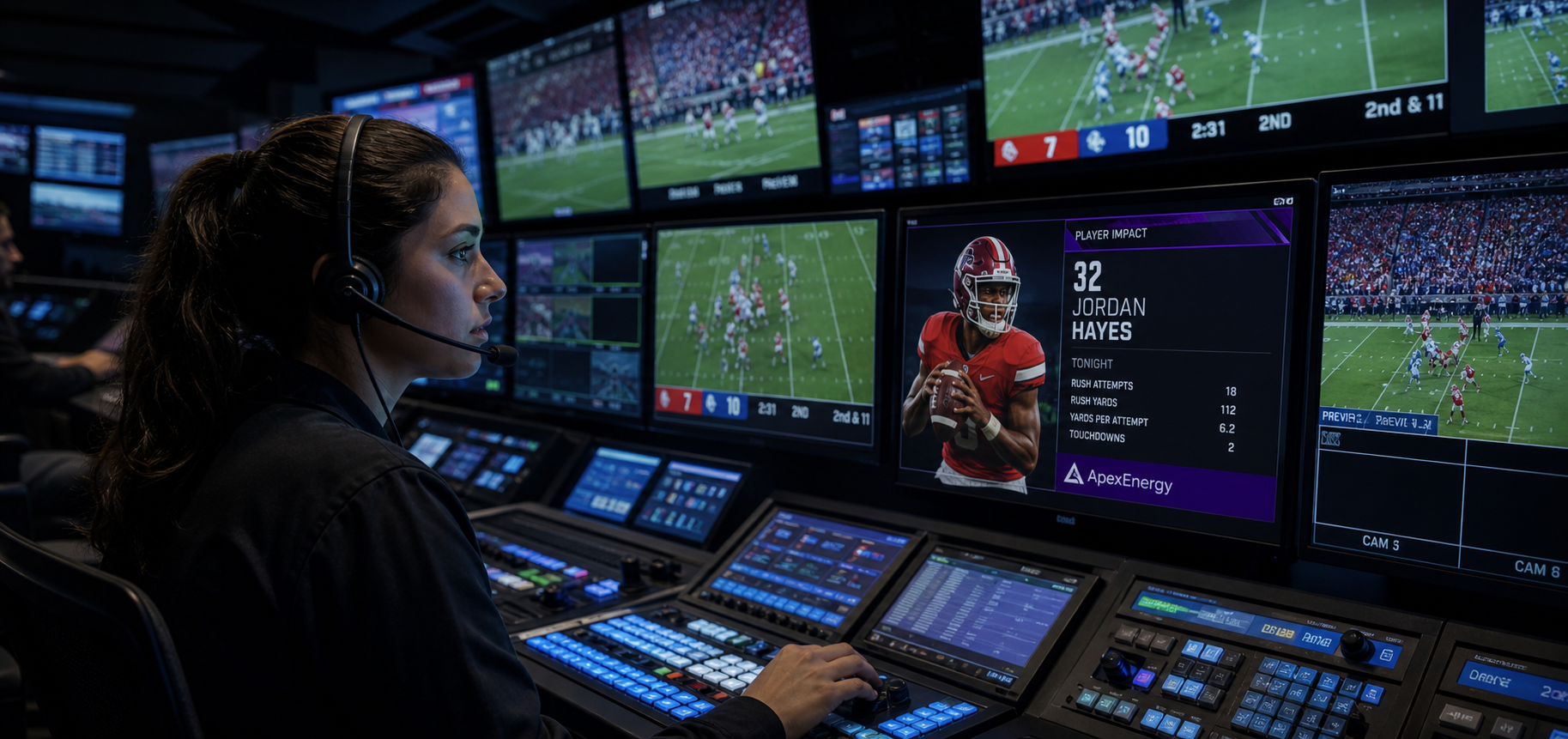
The first two home games are the stress test. Months of planning meet ninety minutes of unscripted live event, and the gap between the run-of-show on paper and what actually happened on the boards becomes visible in a way it never is in August. That gap is not a grade. It is a data set, and it has a short shelf life — the fixes it points to are cheap in September and expensive in November.
Identifying the Operational Friction Points
A key sponsor's logo is misspelled on a third-quarter trivia prompt, and the control room has no way to fix it before the graphic comes down. A walk-on makes the defensive play of the game, and the only thing ready to go is the generic team mark. Neither of those is hypothetical. They are the minute-by-minute failures the opening weeks surface in venues everywhere, and they cluster into two patterns worth naming.
The first is the content gap — the lag between a moment happening and a graphic acknowledging it. By the time a pre-rendered file reaches the board, most of the crowd has already seen the highlight on a phone. The second is the inflexibility tax: what it costs in time and staff attention to make a small change late. A roster correction, a typo, a sponsor asking for something on Thursday for Saturday. When those requests take a production cycle instead of a field edit, the answer becomes no by default, and a venue loses the agility to change its look in seconds rather than weeks.
From Post-Mortem to Mid-Season Tune-Up
A coaching staff watches film on Sunday because the next opponent is six days out, not because the last game can be replayed. The same logic applies to game presentation, and almost nobody applies it. Production debriefs, where they happen at all, tend to happen in December, when the only thing they can change is next year.
The discipline worth borrowing is the timing, not the ceremony. Two games is enough data to see which failures are one-offs and which are structural — a missed graphic in game one is bad luck, the same missed graphic in game two is a workflow problem. Sorting your first two games into those two buckets takes twenty minutes and tells you where the rest of the season's effort should go. Some of what surfaces will point at process; some will point at the production system itself, which is one of the clearer reasons venues move to real-time graphics.
The revenue consequence is the part that gets overlooked. Being able to say yes to a sponsor's late creative request is not a service nicety; it is inventory that otherwise goes unsold. A rigid workflow does not just frustrate the crew. It quietly caps what the sponsorship team can offer.
💡 Related reading: The Rendering Bottleneck: Is Your Videoboard Leaving Revenue on the Table? — how production delays translate directly into unsold high-margin inventory.
Four Questions for Your Next Production Meeting
Put these on the agenda while the first two games are still fresh. Answer them honestly, in the room, with the people who were actually on headset.
1. Sponsor agility. Could we have turned a new sponsor creative request around in under an hour? If not, where exactly did it stop — approval, design, render, or playback? Name the step, not the department.
2. Data and roster accuracy. How fast did player graphics reflect reality, both for pre-game changes and for milestones hit during the game? Anything that stayed wrong on a board for a full quarter belongs on this list.
3. Downtime content. What was on the screens during timeouts and between quarters? Fresh and interactive, or a loop that also ran last season? Fans notice repetition faster than they notice polish. This is the in-season half of your pre-season readiness checklist.
4. Moment capture. Did the game's biggest unscripted plays get something specific, or did we fall back on generic branding? Count the moments you missed. That number is the clearest single measure of how responsive the operation actually is.
Two games is a small sample, but it is the only sample available while there is still a season left to fix. The venues that improve across a year are not the ones that plan hardest in August. They are the ones that treat the run-of-show as something to be revised in week three, and again in week seven, on evidence they collected themselves.
Ready to Elevate Your Venue Strategy?
See how venue4D™ helps leading venues turn live moments into measurable revenue.
Talk to venue4D