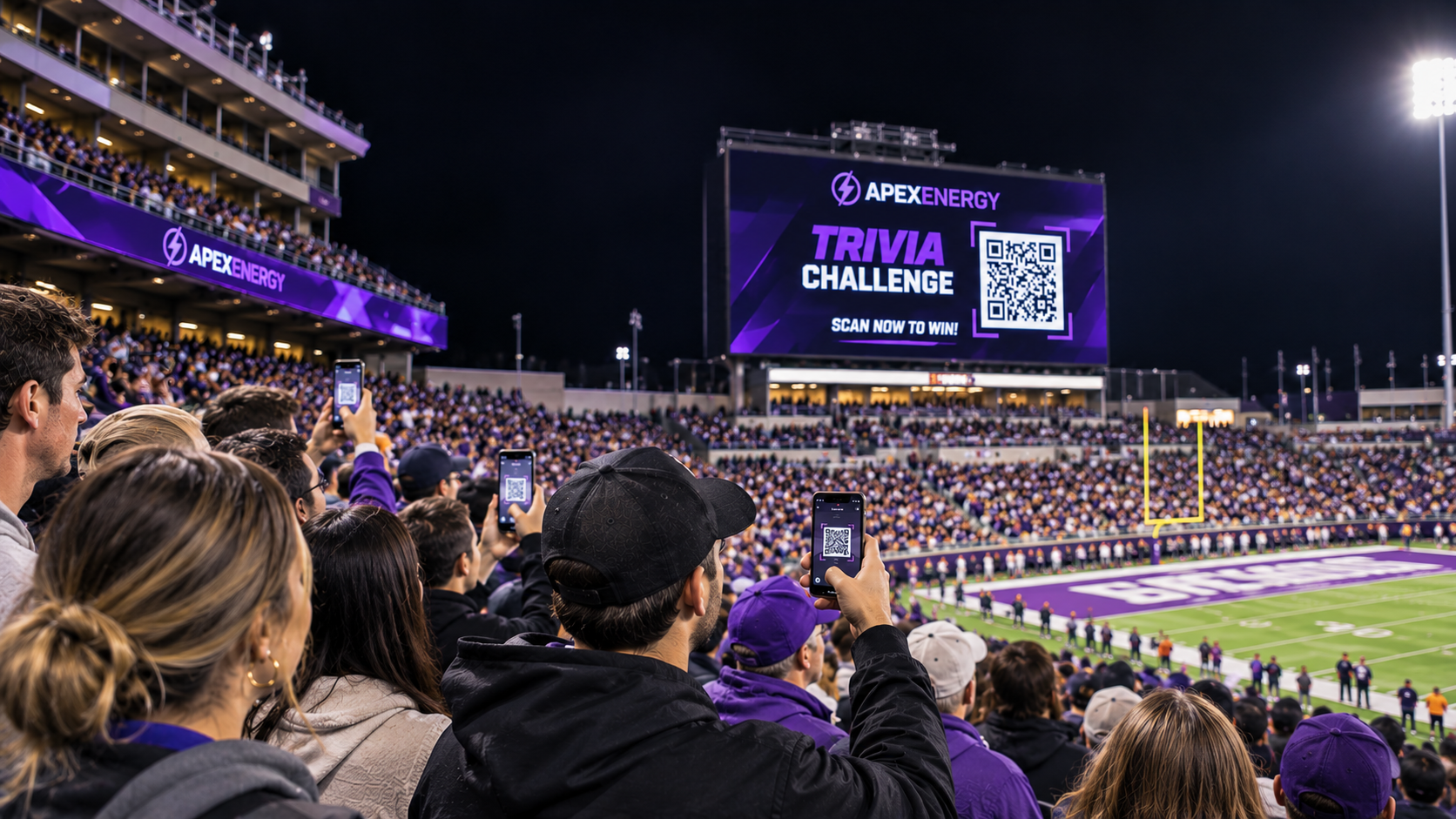
During a November college football timeout, four thousand fans scan a QR code on the main video board to join a sponsored trivia round. On Monday morning, the multimedia rights representative exports those email addresses to prove partner ROI, while the athletic department's development office sits fifty yards away, unaware those fans were even in the building. Treating in-venue data capture as a single-use sponsorship deliverable leaves half its financial value on the table.
The Single-Use Trap in Sponsorship Inventory
Most athletic departments view interactive videoboard moments through a narrow commercial lens. A regional bank or auto group buys a four-game promotion during the overlap of football and men's basketball tips. Fans participate via their smartphones, the collective results resolve on the primary display, and the sponsor receives a batch of opted-in leads. In this standard workflow, first-party data is treated as a disposable byproduct of sponsorship inventory rather than an institutional asset.
That operational habit is expensive. Acquiring verified fan data through paid social campaigns costs athletic marketing teams dollars per lead, yet venues generate thousands of zero-acquisition-cost records every Saturday and Tuesday night. When those records stay trapped in a sponsor-fulfillment spreadsheet instead of flowing into the central CRM, the department forfeits the compounding value of its own crowd. Modern venues are recognizing that breaking down disconnected data silos is the fastest route to higher per-cap yield.
“This unified view enables delivery of more relevant and timely experiences while also serving as a direct monetization engine.”
— Boston Consulting Group
Beyond Media Rights: A Whole New Ballgame for Sports, February 2026
The sponsorship sales team is only the first buyer of an interactive activation. They value volume, completion velocity, and immediate brand recall. They want to know that three thousand fans engaged with their winter tire promotion during the third quarter. Once that partner report is delivered, however, the internal lifecycle of that fan record should just be starting.
Why the Development Office Needs Live Engagement Signals
The second buyer sits down the hall in the development office, and their problem is entirely different. Major gift officers and annual fund directors spend months trying to identify which alumni and community members actually care enough to give. Ticketing records only reveal who purchased a seat on the primary market. Once tickets are transferred via mobile apps or resold on secondary marketplaces, the development office loses sight of who is physically sitting in the lower bowl.
In-venue collective fan interaction solves that visibility gap. When an unrecorded guest in section 108 scans a QR code to vote on the fourth-quarter anthem or join a halftime prediction poll, they identify themselves in real time. More importantly, they demonstrate active affinity. A fan who responds to three videoboard CTAs during a November rivalry game — and returns four days later for the basketball home opener — is exhibiting behavioral signals that standard wealth screening cannot detect.
Feeding those live participation timestamps into the department's CRM transforms donor prospecting. Instead of cold-calling a static list of graduates by class year, development officers can prioritize fans who have already raised their hands inside the venue six times this month. As departments look for practical ways to improve major donor retention and cultivation, tying live game-day participation to constituent profiles turns every timeout poll into a qualification engine for the annual fund.
💡 Related reading: Beyond the Roar: Using Data Analytics to Supercharge Venue Marketing — see how live participation metrics connect on-screen fan moments directly to your broader CRM and revenue strategy.
Architecting Dual-Buyer Data Consent and Routing
Serving both sponsorship and the development office from the same in-venue CTA does not require twice the software or twice the screen time. It requires cleaner data governance at the point of capture. When a fan scans a code on the videoboard, the mobile entry screen must handle data consent transparently, separating institutional communication from third-party partner offers.
A split-consent structure protects fan trust while satisfying both buyers. The primary opt-in grants the athletic department permission to link the interaction to the fan's permanent CRM record for ticketing and foundation outreach. A secondary checkbox — often incentivized by a partner prize draw or concession discount — grants explicit consent to share contact details with the presenting sponsor. This clear boundary is essential for securing the second screen and maintaining compliance with state privacy laws.
Once captured, the routing should happen automatically. Template-driven graphics systems that support enterprise CRM integrations can tag each participant with the exact event, on-screen CTA, and sponsor campaign before pushing the payload to both destinations. The corporate partner gets their verified lead list on Monday morning, and the development officer gets an automated alert that a mid-level donor prospect just attended three consecutive home games across two sports.
Athletic directors and chief revenue officers do not need more fan lists; they need their existing lists to do two jobs at once. Before the December bowl and holiday basketball schedules peak, audit where the data from your videoboard polls and trivia games actually lands after the clock hits zero. If those records only go to an external sponsor recap deck, sit your multimedia rights lead and your development director at the same table and map a shared pipeline into your CRM.
Ready to Elevate Your Venue Strategy?
See how venue4D™ helps leading venues turn live moments into measurable revenue.
Talk to venue4D