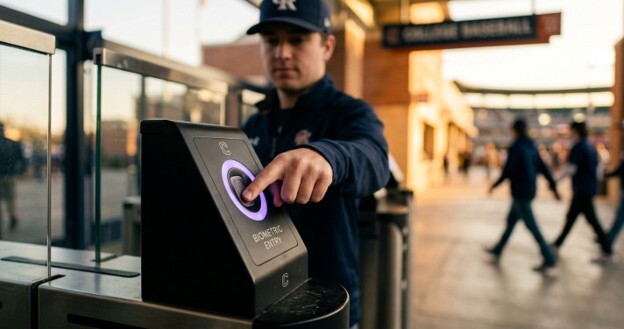
A fan’s experience begins the moment they approach the venue, but long entry lines are creating a costly first impression. For mid-major athletic departments, this friction at the gate isn’t just an inconvenience; it’s a direct drain on ancillary revenue. Understanding the link between entry speed and fan spending is crucial for modern venue profitability.
The Hidden Cost of a Slow Welcome
Picture the scene outside Charles Schwab Field, Omaha, during the College World Series. Thousands of fans, buzzing with anticipation, are bottlenecked at the gates. Their phones are out, not to share excitement but to scan a QR code, fumbling as they get to the front. This friction point, common at venues nationwide, does more than just delay entry; it actively suppresses the ancillary revenue that athletic departments depend on.
The first 15 to 30 minutes a fan spends inside the venue are the most valuable for driving sales of concessions, merchandise, and other extras. When that time is spent in a frustrating queue, the impulse to grab a hot dog or buy a hat diminishes. Industry leaders recognize that a negative arrival experience creates a psychological barrier to spending. The fan journey must be seamless, starting long before the gate.
This "entry gap" represents a significant loss, especially for mid-major programs that rely on in-venue spending to balance budgets. The problem is not the ticket scan itself, but the cumulative effect of thousands of small delays. As mobile ticketing becomes standard, the process has become less, not more, efficient at many venues, highlighting a disconnect between technology adoption and the goal to monetize the complete fan experience.
Biometrics as a Path to Profitability
Leading venues are closing the entry gap with frictionless gate systems, often using biometrics. Biometric entry uses unique physical characteristics—like a fingerprint or facial scan—to verify a ticket holder's identity. Instead of searching for a barcode, a fan simply walks through a sensor. This approach, already common in airports and secure facilities, can reduce entry times from several seconds per person to less than one.
The financial impact of this speed is significant. Faster entry directly translates to more time for fans to explore the venue and open their wallets. The goal is to extend the time fans are actively engaged inside the facility, not stuck waiting outside.
"What we want to do is make this as frictionless as possible from a guest experience standpoint. It allows people to get in the building faster and get to the things they want to do."
— Jason Gannon, Managing Director, SoFi Stadium and Hollywood Park
That principle applies universally. For a collegiate venue, "the things they want to do" directly translates to per-capita spending. Biometric systems not only accelerate entry but also generate valuable data. By understanding arrival patterns, venues can optimize staffing at concession stands and merchandise kiosks, further reducing friction and turning data into a strategic advantage.
💡 Related reading: Beyond the Roar: Using Data Analytics to Supercharge Venue Marketing — discover how to turn live event data into tools that drive fan engagement and prove sponsor ROI.
The Mid-Major Opportunity
While often associated with large NFL stadiums, frictionless entry technology is becoming increasingly accessible and presents a powerful opportunity for NCAA Division I and II programs. For these institutions, where every dollar of ancillary revenue counts, the ROI on a smarter gate system can be realized quickly. The investment is not about competing with professional venues on scale, but about maximizing the efficiency of every fan's visit.
Implementing such systems does not require a complete overhaul of existing infrastructure. Modern biometric entry points can integrate with existing ticketing partners, acting as a faster front-end to a familiar back-end. This makes adoption practical for IT departments managing lean budgets. The focus should be on creating measurable improvements that directly contribute to the bottom line, a key strategy for controlling operating costs while unlocking revenue.
For a mid-major athletic department, shaving even 30 seconds off the average entry time for 5,000 fans at a basketball game can add over 40 hours of collective in-venue time per event. That is 40 more hours for fans to purchase food, drinks, and apparel. When multiplied across an entire season of sports, the financial argument for optimizing the gate becomes compelling.
The fan arrival experience is no longer a simple operational task; it is a critical revenue-generating opportunity. Long queues and inefficient mobile ticketing processes are creating a significant gap between potential and actual ancillary spending. By embracing practical, frictionless entry technologies, collegiate venues can close that gap, improve fan satisfaction, and build a more resilient financial model where revenue generation begins the moment a fan arrives, not after they finally clear the gate.
Unlock New Revenue in Your Venue
Are outdated systems leaving money on the table? Discover how venue4D’s platform streamlines operations and unlocks dynamic new digital sponsorship inventory.
Book a Strategy Call